IPFinal: twenty-odd IP and network checks on one site
IPFinal (ipfinal.com) is an IP and network-environment checker with no sign-up. The home page checks the visitor’s own exit IP, and the “All tools” menu holds more than twenty other tools. They fall into four groups: looking up a given IP, checking your own connection, checking whether specific services will work, and general network utilities. The examples below use Google Public DNS, 8.8.8.8, so anyone can reproduce them.
1. Looking up an IP
Enter an IPv4 or IPv6 address or a domain. The result page has five tabs: IP info, risk checks, location, BGP topology and timeline.
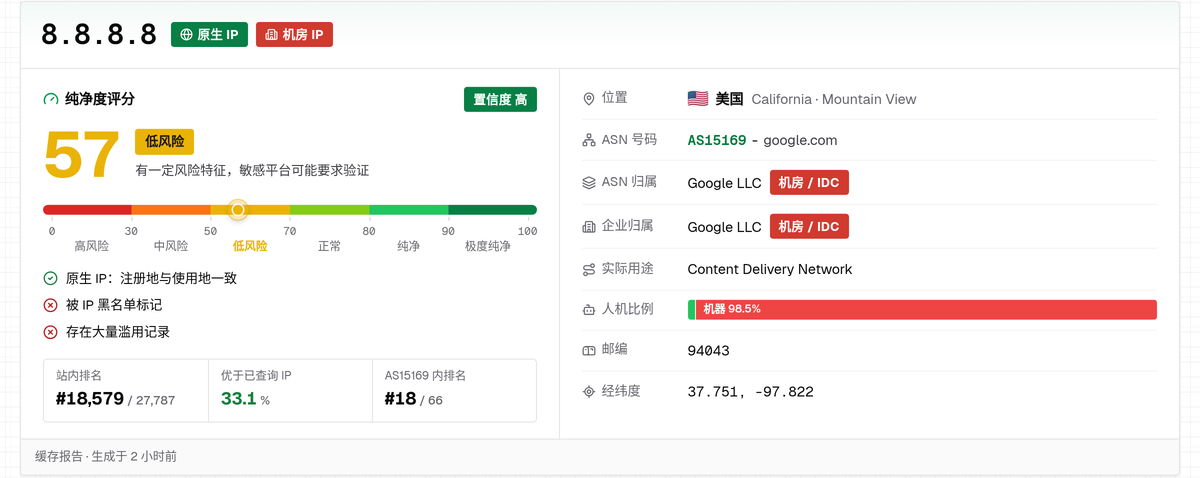
Purity score
A score from 0 to 100 in six bands, from high risk to pristine. 8.8.8.8 scores 57, low risk. Next to the score the page marks whether the IP is native or broadcast and whether it is datacenter or residential, followed by its rank among all IPs looked up on the site and within its own ASN. 8.8.8.8 ranks around 20,000th of roughly 31,000 site-wide and 21st within AS15169.
Risk checks
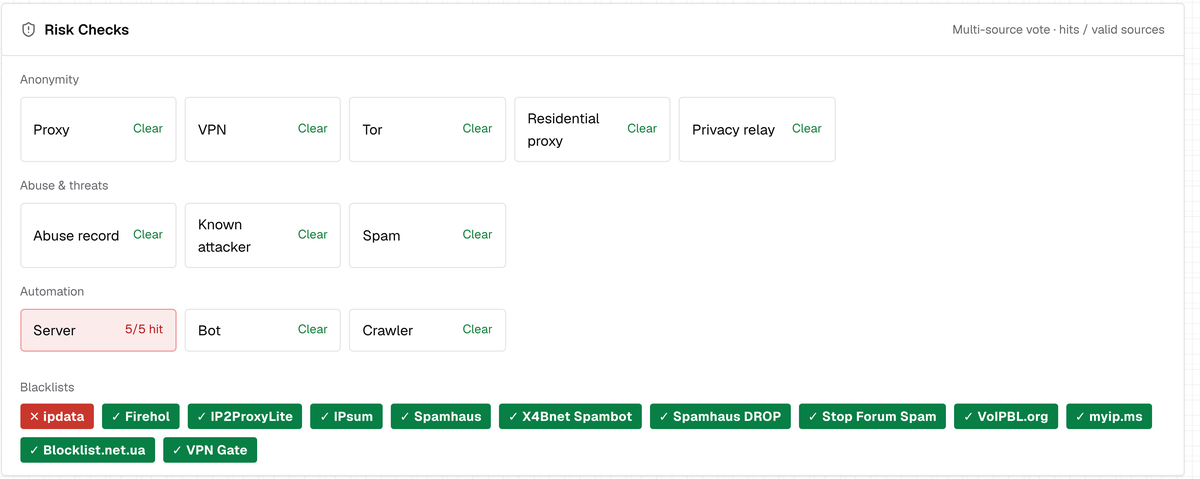
Four groups, each line stating how many sources hit out of how many were valid:
- Anonymity: proxy, VPN, Tor, residential proxy, privacy relay
- Abuse and threats: abuse records, known attackers, spam
- Automation: server, bot, crawler
- Blacklists: twelve lists including ipdata, Firehol, Spamhaus, Spamhaus DROP, IPsum, Stop Forum Spam and VPN Gate. A green tick means not listed, a red cross means listed
For 8.8.8.8 every anonymity check is clear, the server check hits 5/5, and only ipdata lists it.
Location, neighbourhood and BGP
- Location is cross-checked across MaxMind, IP2Location, DB-IP and IPInfo, with each answer shown side by side, plus time zone, currency and calling code
- ASN usage: the share of each IP type among identified addresses in the same ASN. In AS15169, 98.54% are datacenter, 1.06% search crawlers, 0.28% CDN nodes
- BGP topology: upstream paths from the ASN to the global Tier 1 backbones, weighted by the share of paths through each network, built from public route collectors. AS15169 reaches 14 Tier 1 networks
- Timeline: how the IP’s score and attributes have changed over time
Use case fit
Scores for TikTok, Facebook, X, e-commerce, streaming and AI apps, estimated from known risks. The site says plainly these are not platform tests or success rates, and its knowledge base has an article explaining what each scenario weighs.
At the bottom you can copy the report, copy a link, or export a PNG through “Share screenshot”, choosing desktop or mobile layout, summary or full report, with an option to hide the last two parts of the IP.
2. Checking your own connection
These tools test the visitor’s current browser and network and cannot be pointed at someone else’s IP. With a proxy on, they show the proxy exit.
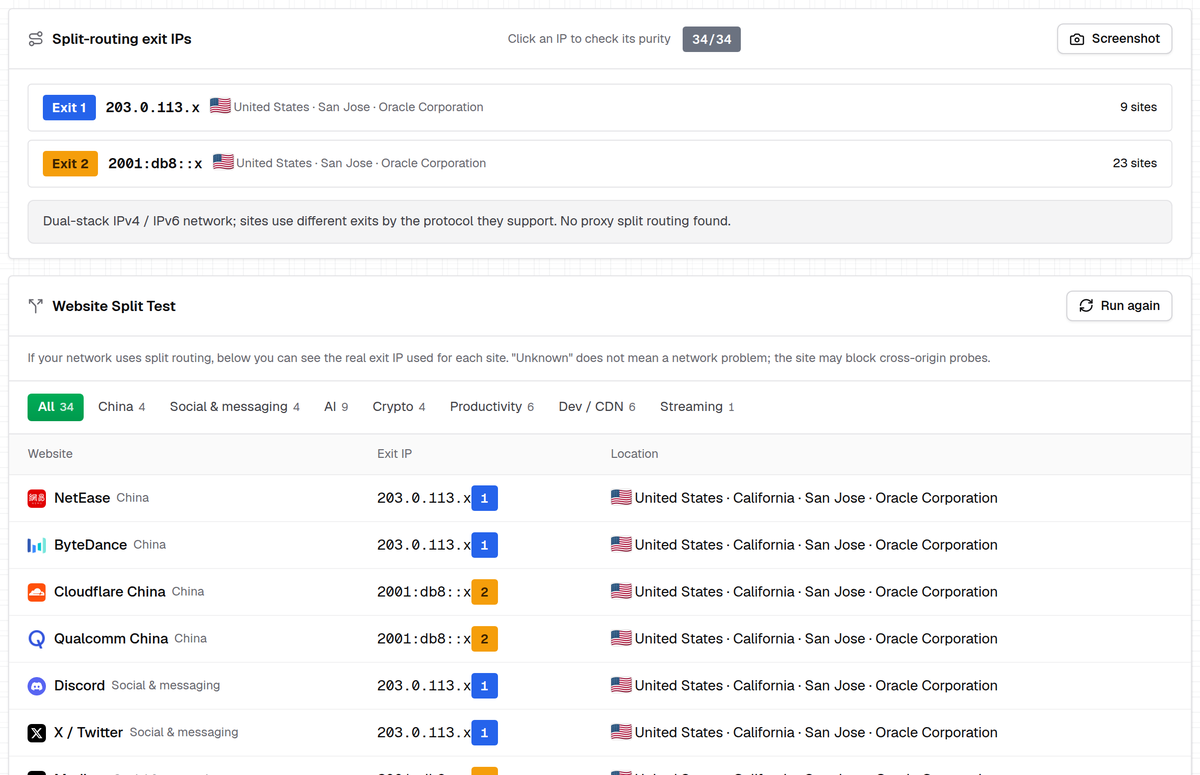
Split-routing test
The browser visits 34 sites and records the exit IP each one saw, grouped as China, social and messaging, AI, crypto, productivity, dev and CDN, and streaming. If a proxy rule sends one site out directly, an extra exit appears in the table. On a dual-stack connection there are usually two exits, IPv4 and IPv6, with each site picking by the protocol it supports, and the page notes that this is not split routing.
Leak test
- DNS leaks: the browser resolves six random subdomains, the site records which resolvers actually queried for you, and compares their carrier and country with the exit IP
- WebRTC leaks: lists ICE candidates, separating local host candidates (hidden behind mDNS by modern browsers) from public addresses obtained through STUN
- Fixes are listed on the page: a WebRTC Network Limiter extension for Chrome, media.peerconnection.enabled set to false in Firefox, TUN or global mode in the proxy client, and remote DNS or Fake-IP for DNS
IPv6 check
Visits sites with only an A record, only an AAAA record, and both, measuring connectivity and latency. The scoring is stated on the page: 3 points for working IPv4, 5 for working IPv6, and 2 more when a dual-stack browser prefers IPv6, out of 10.
Browser environment and UA parser
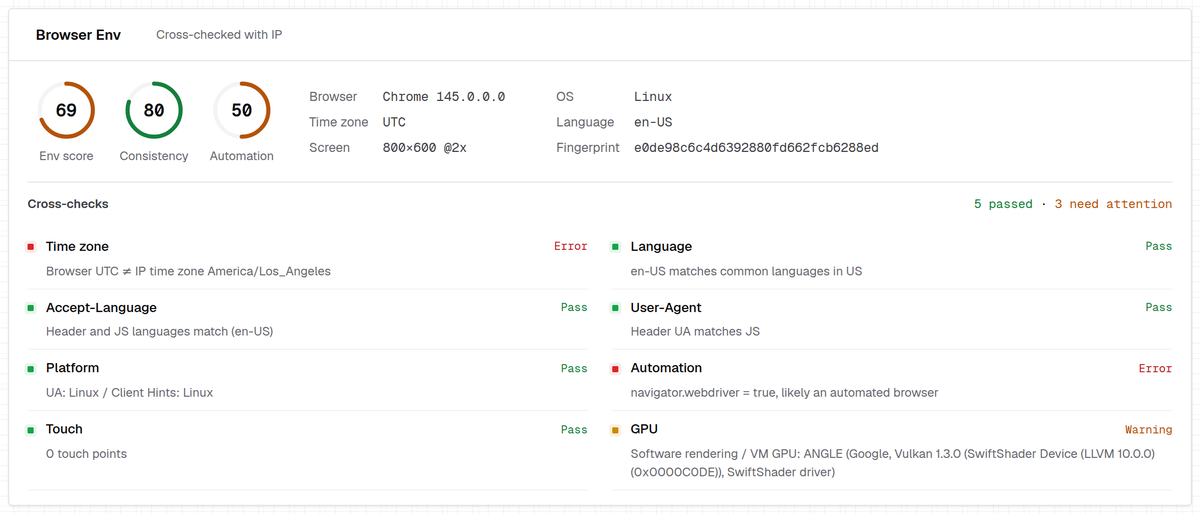
The environment page collects a fingerprint and cross-checks it with the IP, producing an environment score, a consistency score and an automation score. Checks cover browser time zone against the IP’s time zone, language, Accept-Language, user agent against Client Hints, touch points and GPU. navigator.webdriver set to true is flagged as automation, and software rendering such as SwiftShader is flagged as a virtual machine. The UA parser breaks down browser, engine, OS, device and crawler identity, with ready-made samples such as iPhone Safari, Android WeChat, Googlebot, GPTBot and curl.
3. Will a given service work
Claude check
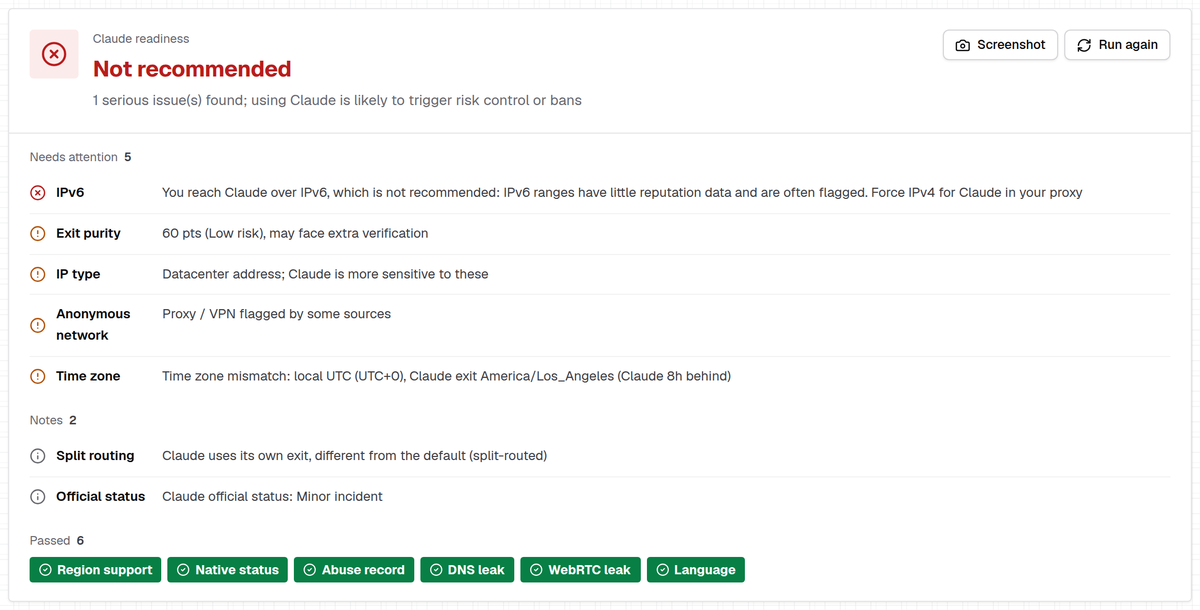
One page combining the exit used for Claude, its purity, region support, native status, abuse records, DNS and WebRTC leaks, time zone and language, ending in a verdict. Issues are sorted into serious, needs attention and notes, each with concrete advice such as forcing IPv4 for Claude in the proxy. It also shows whether Claude goes out through a different exit from the default one, and whether Anthropic’s status page currently reports an incident.
AI availability
Tests Claude, ChatGPT, Grok, Perplexity, Mistral and Poe in one run. It reads the real exit IP and region through each service’s Cloudflare node, then combines exit purity and official status into a verdict. The page warns that with a purity below 50, a service can still throw captchas or ban accounts even when the region is supported.
Platform check
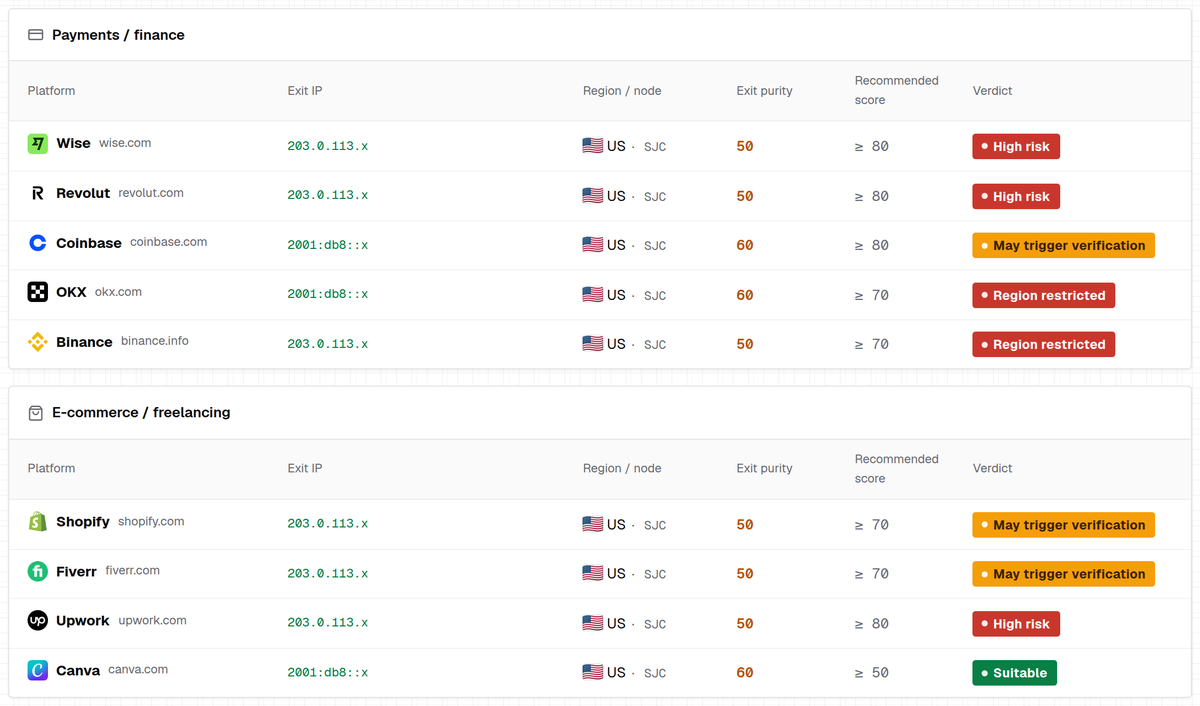
Sixteen platforms in four groups: payments and finance (Wise, Revolut, Coinbase, OKX, Binance), e-commerce and freelancing (Shopify, Fiverr, Upwork, Canva), social and content (X, Discord, LinkedIn, Quora, Medium and others), and streaming. Each gets its exit, node, exit purity and a recommended threshold; Wise and Upwork want 80 or more, Discord and Canva 50. Below the threshold the verdict is “high risk” or “may trigger verification”, and region-restricted platforms are marked separately.
Cloudflare and CDN
- Cloudflare check: the edge node you hit, whether WARP is in use, the connection protocol (HTTP/3, TLS version) and Zero Trust status. It also runs a real Turnstile challenge in invisible and managed modes, and only a server-side PASS counts
- CDN check: 29 CDNs in one run, including Cloudflare, Akamai, Fastly, CloudFront, Bunny and ByteDance, with the node city, cache status and latency for each, and the evidence used (cf-ray, X-Served-By, X-Amz-Cf-Pop headers) listed under every entry
4. General network tools
- Global ping: ICMP ping from Globalping public probes, selectable by world, Asia, Europe or Americas. 8.8.8.8 got 16 probes this time, all reachable, fastest 0.6 ms from Frankfurt
- Speed test: download, upload, latency and jitter over Cloudflare, about 8 seconds per phase. Throughput is the 90th percentile of samples above 1 MB, close to how speed.cloudflare.com counts; a run uses a few dozen MB
- DNS lookup: queries Alibaba DNS (inside China) and Cloudflare and Google (outside) over DoH and compares the answers, useful for spotting CDN steering or DNS poisoning. Supports A, AAAA, CNAME, MX, TXT, NS, CAA and HTTPS records
- Whois / RDAP: registration data for IP ranges, ASNs and domains
- ASN details: holder, registration date, announced IPv4 and IPv6 prefixes, upstream and downstream neighbours, with routing data from RIPEstat. AS15169 announces 1,264 IPv4 and 177 IPv6 prefixes. There is also a /16 neighbourhood profile with the site’s average scores
- IP calculator: network, mask, host range and subnetting, computed locally in the browser
- IP map: location on a map with risk tags and range details
5. The rest
- IP info card: an image showing each visitor’s own IP, purity, browser and OS, for blog posts or forum signatures, with Markdown, HTML and BBCode snippets. Three layouts, ten themes, and optional tags such as “native IP”, “home broadband” or “CN2”
- Service status: official status for 26 services including Claude, OpenAI, Cloudflare, GitHub, Vercel and Discord, incidents pinned to the top, refreshed every 5 minutes
- Knowledge base: nine explainers on IP types, how risk scores work, WebRTC and DNS leaks, browser fingerprints, and keeping a Claude account stable
- Statistics: total lookups, score distribution and the countries of queried IPs, anonymised. At the time of writing, 83,813 lookups in total and 12,641 in the last 24 hours
Reading the results
- Purity is a weighted blend of several sources, and different checkers often disagree about the same IP, so treat any single score as a hint
- Use case fit, platform verdicts and the Cloudflare risk index are estimates. The Cloudflare page states the site has no enterprise plan and derives that score from limited Cloudflare data combined with other sources
- Results in the “your own connection” group change with your proxy rules, so test again after switching nodes
Address: ipfinal.com, no account needed; language and light or dark theme switch from the top right.